

3 (and a half) strategies I use for outlining a book
Presented in increasing order of how unhinged I get

Click the player above if you want the audio version of this post! (But don’t forget to scroll to the bottom for a picture of my very cute dog!)
Long long ago, I was a pantser or a discovery writer or whatever you want to call it. I had an idea, I started writing, and I saw where it went. At least 90% of the things I started, I never finished. Often, I’d write myself into a corner, or I’d lose the thread and not know where to go. Once I started outlining, I knew I’d never go back. Now, nearly all of the projects I finish outlining become a completed book!
I had planned to do a post about my process for outlining a book, but when I sat down to think about it (yes, I outlined my post about outlines), I realized it wasn’t going to work to say, “here is the one way I do everything.” It varies, and due to the ADHD goblins steering the ship, I have minimal control over what works for my brain at any given time.
Once I figure out the story/plot, everything does end up in a spreadsheet (I’ve previously shared a bit about my use of spreadsheets in my writing process), but how the goblins and I get to that point varies. So today, I’m going to talk about myriad ways I’ve planned out a story. (And by myriad, I mean 3 ½ ways. We won’t be here for eternity.)
As a note: After I finish a first draft, I also create a reverse outline, and THEN I begin a revision outline. (I don’t know what I was doing with my life when I just winged it and didn’t have 3+ outlines for every single manuscript.) If you’re not a plot ahead of time kind of person, the majority of my methods can also work when figuring out developmental revisions (edits to overall story structure/plot/pacing) after you’ve completed the first draft.
So, let’s dive in!
Before the Outline: The Brain Dump
All my books start with a blank document and stream of consciousness of every idea that comes to me. Very broadly, I’m trying to tell myself a story, and if I’m not engaging enough or not making sense, then I try telling myself a slightly different story and another until I have a concept that catches my brain and holds fast.
To have a story that works for me, I need to know my main character(s), a bit of their personality (doesn’t need to be everything!), and the broad strokes of what their life is like without the events of the book. I also need to know their inciting incident—what changes in their life to make their story worth telling. Once I have those locked in, I’m generally ready to move into actual outlining.
(Weirdly, I also absolutely must know a character’s favorite drink before I start writing, but often, I can get through outlining before I need to know whether they’re drinking green tea or red wine or hot cocoa after a stressful day.)
Outline Method #1: The Basic B
At this point, I typically have something resembling a fairly bad elevator pitch and/or query blurb. It introduces the character, the conflict, and the stakes. I still need to figure out the journey, though. No idea arrives fully formed, so it’s time for bullet point trial and error!
With the overarching concept in mind, I start listing out a series of events that make up the story. If I get stuck, I switch back to brain dump mode and narrate ideas for myself until something clicks and I can return to the bullet points.
A lot of the time, these points sort of naturally organize and will typically end up as either individual chapters or scenes. Sometimes I’ll condense two points or split them, if I realize those parts would be better kept in one scene or spread out over two or more.
This method works especially well for single timeline, single POV stories, but it can work for more complex structures. Or for those, I might get a little fancier.
Outline Method #1.5: The Fancy Flow
From my brain dump, I can pretty much always get a sense of whether this will be single or dual timeline and single or multiple POV. With dual timeline, both need to have a complete arc, but the pacing and beats also need to match up between them. Each one really needs its own mini outline. I sometimes plan both simultaneously, but more and more, I find that doing one then the other helps me pull together the best pacing. I create a numbered list and for each number, I describe what happens in that chapter/scene. Once I have the two lists, I do a 2-column layout in Word and start tweaking to make sure the two timelines align in terms of pacing and beats, as well as to make sure the information unfolds in the order I need it to. This also helps me determine whether this will be an alternate chapters kind of dual timeline or one where we spend multiple chapters in one, then switch.
Outline Method #2: The Grid Lover
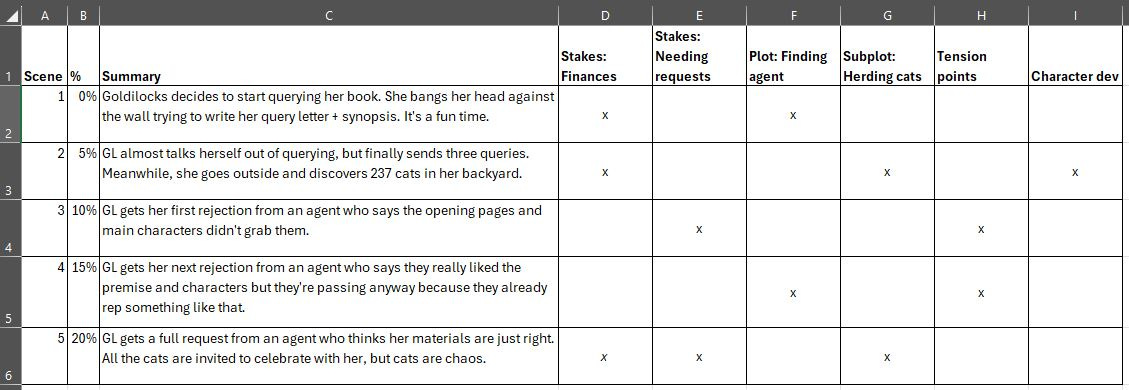
I’m calling it a grid, but okay, yeah, this one is a spreadsheet. This works best for me if I have an idea of what comes later and need to fill in earlier parts of the story. I start with a blank table. I do one column with percentages listed out (i.e., how far through the story that row of the table will be, generally in 5-10% increments), and often I do 1 or 2 columns with different beats/plot structures. I don’t adhere to these strictly, but sometimes when I’m feeling stuck outlining, thinking through the plot beats for what comes next is helpful.
I have one wide column for writing out what happens, of course.
And then I have a few columns on the far right. I label these with stakes, tension points, and/or plot. Not generically “stakes,” but the specific ones for the story. Sometimes this is more than one column—maybe one for personal stakes, one for grander stakes. As I fill in each chapter/scene description, I check off one or more of these to indicate whether that scene is moving the story forward in that domain. Is it raising the stakes? Is it increasing the tension between characters? Is it progressing the plot?
If a scene doesn’t check at LEAST one of those boxes, then either the scene needs to go, or I need to change the outlined events.
Outline Method #3: The Conspiracy Theorist
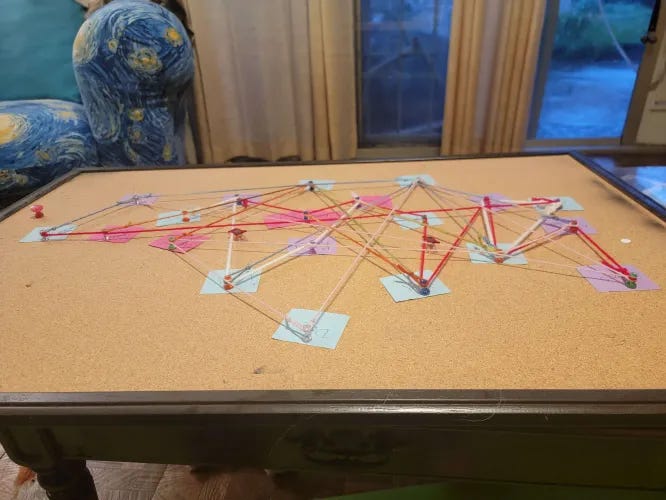
Do you own a large corkboard, assorted scratch paper, and several colors of string? Great. You’re ready to solve a crime and/or plot a book! I only did the actual murder board style recently, but I have used this general approach in other ways in the past, like with a large sheet of posterboard or butcher paper and some sticky notes and markers. I’ve even just done it with scraps of paper spread out on my coffee table. Anything works. It’s really just to have something visual to work with.
With different colored cardstock/sticky notes/scrap paper, I write out 1) each character whose existence impacts the story (excluding background extras), 2) each location/setting, 3) any plot devices, secrets, clues, or other information the characters and/or reader discover along the way.
I lay these out in roughly the order I want them introduced, but this isn’t a permanent arrangement. Things can change! But as I’m laying them out, I’ll often realize things like, “this part of the story has to happen before this other one, because the characters need such and such information first.”
Once they’re arranged how I want, I use the string or a marker to draw the causal connections between each—X happens BECAUSE of Y. This actually works really well to do backwards: starting at the end of the story and drawing a line to each event that has to precede the current point. (Cards will be rearranged!) Ideally, there should be one continuous line that runs through the whole story. It doesn’t need to touch every card, but there shouldn’t be breaks or gaps. If there are, something new needs to be introduced to connect those!
In other colors of string or marker, I also do lines to connect a continuous thread for the subplot, which should also intersect with the main plot in at least a couple places (shouldn’t exist entirely independently), then threads for character connections, which don’t need to be continuous, but they should intersect with some plot points.
Sometimes, after all the lines are drawn, I’ll have a card that isn’t connected to anything. Even if I think it’s a super fun idea or character or place, it probably needs to get cut, because it’s not serving the story in any way!
Pulling it all together
All of these are for me to figure out the flow of the story. Where is the plot going? Where are the points of conflict? How do things connect? How does it all get resolved? Once I have that, then I bring it into a tidy list and make sure I have sufficient information for each scene/chapter.
Over time, what I’ve found works is to have about 3 parts, usually 1-2 sentences each:
1. The start point for the scene – Where is the character? What are they doing?
2. The movement – What main action is the character taking, or what main action is happening to them? How do they react or feel?
3. The end point for the scene – What have they learned? How are they feeling about it? What’s their motivation to go on to the next chapter or scene?
For example:
Gwen goes to a job interview at a cafe. She meets with the owner and tries her best but totally bombs it. She drives home feeling hopeless, making plans to fix her life by stress baking.
I often see other ADHD writers say plotting takes the excitement/novelty/dopamine out of the process. For me, it’s a balance. I need to know where I’m going, because I’m a side tangent Olympian. Unchecked, I will veer off course and never return.
However, I don’t plan absolutely everything. There’s a lot of space in there still for novelty and discovery. With the example above, as I wrote, I learned more about the café owner’s personality, I got to explore and have fun with the dialogue to make Gwen crash and burn, etc. The goal posts are there, but I can go adventuring between them and still have some guardrails to keep me on track and end things where they need to end in order to get me to the next scene.
How do you outline?
I’m a writing craft magpie. I love taking shiny bits and pieces from other people’s processes and integrating them into my own. What’s your method for outlining a story? Or if you’re not a plotter, what pieces do you need in your head before you feel ready to start writing?
omg "all the cats are invited to celebrate but cats are chaos"😂😂😂